
Revenue Growth · 11 min read
Are You Losing $3,000–$10,000/Month? How Auto Repair Shops Leak Revenue

Steve Bang is the founder of Garixo and a software engineer with hands-on experience working in auto repair shops. He builds practical technology to help independent repair shops manage their businesses more efficiently.
Published Mar 01, 2026
Most small auto repair shops lose $3,000–$10,000/month — not from bad work, but from invisible inefficiencies. See exactly where the money goes and how management software fixes it.
Most shop owners aren't losing money because they're bad at fixing cars. They're losing it because the business side runs on memory, paper, and habit — and those systems have invisible gaps.
According to the Automotive Service Association (ASA), independent repair shops handle over 75% of post-warranty vehicle maintenance in the U.S. Yet most of them still rely on manual workflows that quietly drain revenue every single week — not from bad work, but from missed charges, unbilled parts, and appointments that never got followed up.
This article breaks down exactly where that money goes — six specific profit leaks, with real dollar estimates for each — and what it takes to stop them.
Quick Answer: Small auto repair shops lose between $3,000 and $10,000 per month due to manual work orders, paper invoice errors, missed appointments, poor inventory tracking, and time wasted on administrative tasks. Garage management software solves most of these problems by automating and centralizing shop operations.
Is Your Shop Showing These Warning Signs?
Before we get into the numbers, run through this quick self-check. If you recognize two or more of these, you're almost certainly losing money each month:
- You've sent an invoice and realized later you forgot to charge for a part
- A customer no-showed and you didn't have a reminder system to catch it
- A technician had to stop work to hunt down a work order or part record
- You can't say off the top of your head what your average repair order value was last month
- A regular customer went elsewhere and you only found out by accident
If any of those hit close to home, read on — the next section shows exactly what each of those is costing you.

Where the Money Is Actually Going
When shop owners think about profit, they focus on labor rates and parts margins. Fair enough. But the real money loss usually isn't in the pricing — it's in the execution. Here are the six most common places auto repair shops bleed revenue without realizing it.
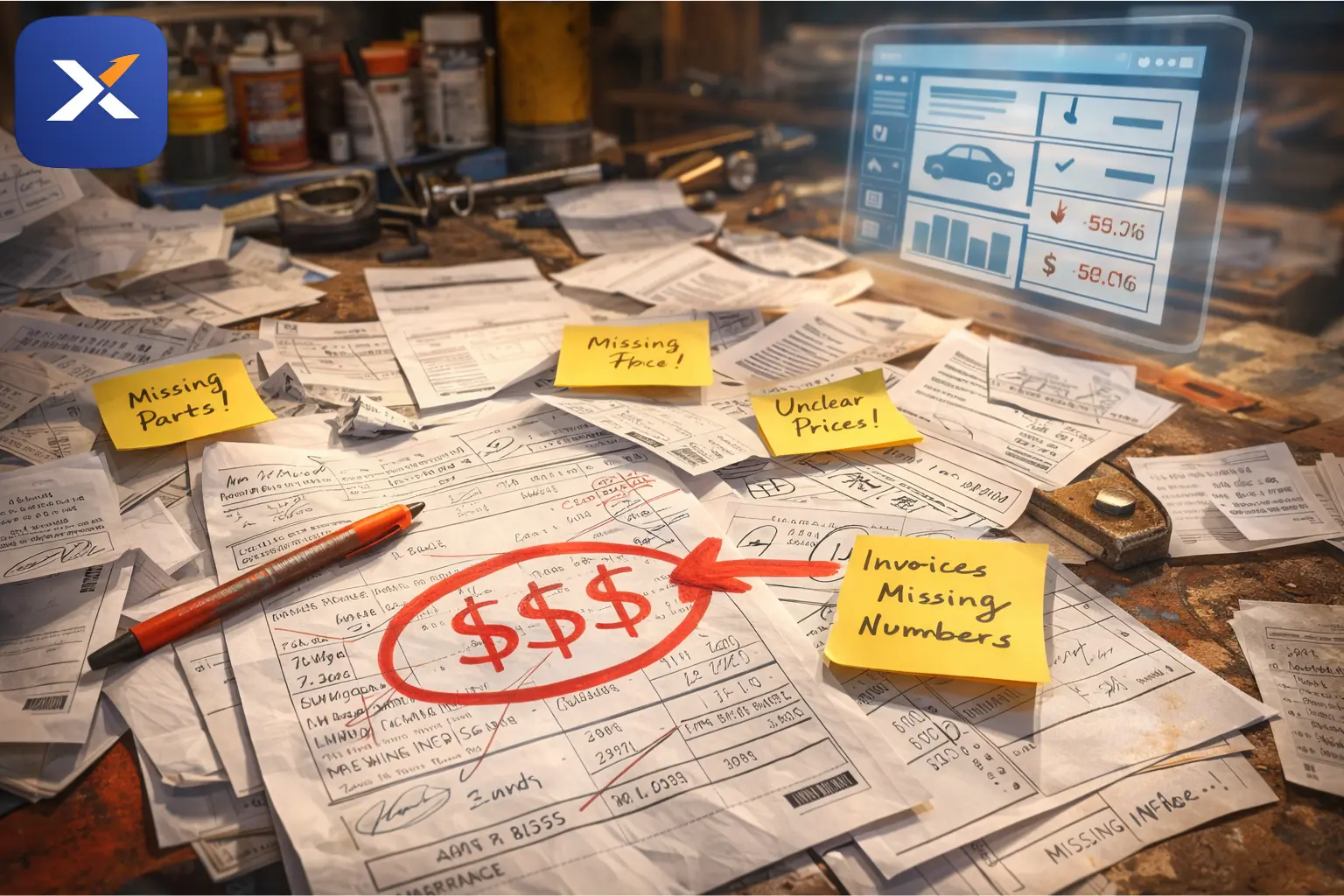
1. Paper Invoices and Work Orders — The Billing Gap
Paper invoice errors are one of the most common — and most overlooked — profit leaks in small shops.
A paper work order gets written up fast, but then what? It sits on a clipboard. Someone forgets to add two hours of diagnostic time. A part gets used but never logged. The customer pays, but the invoice doesn't reflect the actual job.
That kind of under-billing adds up fast. Even if you're only losing $50–$100 per repair order, at 40–60 jobs a month, that's $2,000–$6,000 in missed revenue — every single month.
Manual processes also create errors that damage customer trust. According to a 2023 AAA consumer survey, billing surprises are among the top reasons drivers don't return to the same shop. A customer who gets the wrong invoice or an unexpected charge is unlikely to come back — and won't refer anyone either.
Monthly estimate: $800–$2,500 lost to billing errors and under-invoicing.
2. Missed Appointments — The Empty Bay Problem
Reducing missed appointments at your auto shop isn't just about sending reminder texts. It's about the compounding cost when a slot goes unfilled.
Consider this: one missed appointment on a $300 oil change and brake job, five days a week, is $1,500 a week — or $6,000 a month — in lost potential revenue. Even if only a fraction of those no-shows could have been recovered with a simple reminder system, that's still real money walking out the door.
Paper-based systems and manual phone calls don't scale. They rely on someone remembering to make the call, which means it often doesn't happen.
A good garage management system handles automated appointment reminders so your front desk — or you — aren't chasing customers down by phone. Studies on appointment reminder systems consistently show no-show rates drop by 20–40% with automated SMS or email reminders — a finding that translates directly to service-based businesses including auto repair.
Monthly estimate: $500–$2,000 lost to no-shows and unfilled bays. For a deeper dive into fixing this specific leak, see auto repair shop no-shows are draining your revenue.
3. Unbilled Parts — Inventory You're Giving Away
Garage inventory mistakes might be the sneakiest revenue killer in the shop.
Here's a scenario most shop owners recognize: a technician pulls a part from the shelf, uses it on a job, but it never makes it onto the invoice. Over the course of a month, those small parts — filters, sensors, belts, fluids — add up to hundreds of dollars in unrecovered costs.
On the flip side, shops that don't track inventory properly end up over-ordering or ordering the wrong parts, tying up cash in stock that sits on the shelf for months. The NADA (National Automobile Dealers Association) reports that parts obsolescence is one of the top three causes of excess working capital consumption in independent service operations.
Proper inventory tracking directly impacts your bottom line in two ways: you stop losing money on unbilled parts, and you stop wasting cash on excess stock.
Monthly estimate: $300–$800 lost to unbilled or mismanaged parts.
4. Manual Work Orders — Lost Technician Hours
Every minute a technician spends writing up a work order by hand, looking for a clipboard, or waiting on a part verification is a minute they're not turning wrenches.
At $90–$120 per flat-rate hour — in line with Bureau of Labor Statistics data on automotive service technician wages — that wasted time has a direct dollar value. If each technician loses 30 minutes a day to administrative friction, that's 2.5 hours a week per tech. For a shop with three mechanics, you're looking at 7–8 hours of unbillable time weekly.
That's essentially one full lost labor day every week — just from paperwork inefficiency.
The fix isn't hiring more people. It's removing the friction with digital work orders that are fast, trackable, and attached to the right job automatically.
Monthly estimate: $400–$1,200 lost to technician admin time. Admin friction is only part of this leak — see why your shop is losing $40,000 a year in unbilled labor for the fuller picture of billable time that never makes it onto an invoice.

5. Lost Repeat Customers — The Retention Drain
Repeat customers are the lifeblood of an independent shop. They're cheaper to retain than new customers are to acquire, and they refer their friends.
But without a system tracking service history, follow-ups, and maintenance reminders, most shops lose touch with customers after the repair is done. The customer doesn't hear from you, they forget when their next service is due, and they end up at a competitor.
Research by Bain & Company shows that increasing customer retention by just 5% can increase profits by 25–95%. In a small auto repair shop, that math is even more direct: a customer who comes in twice a year instead of once is worth double the lifetime revenue, at near-zero acquisition cost.
Auto repair shop workflow improvement isn't just about speed — it's about staying connected to customers between visits. A shop that sends a service reminder six months after an oil change doesn't need to advertise as heavily. The customer relationship does the work.
Monthly estimate: $500–$2,000 lost to repeat customers drifting to competitors.
6. No Data, No Decisions — The Management Blind Spot
Here's something most small shop owners don't have: a clear picture of what's actually happening in their business.
- Which technician is completing the most jobs?
- Which services have the best margins?
- How many appointments were missed last month?
- What's your average repair order value?
Without answers to these questions, you're making decisions based on gut feeling. Sometimes that works. More often, it means you're optimizing the wrong things.
Shop management software ROI comes not just from saving time and reducing errors, but from giving owners the data they need to make smarter decisions. The ASA reports that the average independent shop's repair order value sits between $300–$400. If your average is $240, that gap isn't a pricing problem — it's a billing accuracy problem, and the data shows you where.
Monthly estimate: Harder to quantify — but the shops that can't measure this are the ones losing the most.
The Real Cost: What These Leaks Add Up To Monthly
Here's a conservative breakdown across all six categories:
| Profit Leak | Monthly Loss Estimate |
|---|---|
| Paper invoice errors and under-billing | $800 – $2,500 |
| Missed appointments and empty bays | $500 – $2,000 |
| Unbilled or mismanaged parts | $300 – $800 |
| Technician time lost to manual admin | $400 – $1,200 |
| Lost repeat customers from no follow-up | $500 – $2,000 |
| Conservative total | $2,500 – $8,500/month |
For many shops, it's higher. This isn't about blaming the shop owner — these are systemic problems that come with running a paper-based or partially-manual operation. The cost of not using garage software is real, even if it's invisible on your P&L — see how much shops running without software specifically lose for a closer look at that comparison.
Want to calculate your shop's specific number? Use the free Auto Repair Shop Profit Calculator to estimate your monthly revenue and margin in minutes.
How Garage Management Software Fixes Each of These Problems
A solid garage management software doesn't replace your people — it makes them more effective. Here's how it addresses each of the six leaks above directly:
Leak #1 — Paper invoices: Digital work orders auto-populate labor and parts from the moment the job opens. Nothing gets missed because the system tracks everything in real time. Invoicing takes one click, not a manual re-entry.
Leak #2 — Missed appointments: Automated reminders go out 24–48 hours before the appointment. No phone calls required. No-show rates consistently drop 20–40% with reminder systems in place.
Leak #3 — Unbilled parts: Parts used on a job are logged and automatically added to the invoice. Nothing leaves the shelf unbilled. Inventory tracking also flags low stock so you're never over-ordering to compensate for uncertainty.
Leak #4 — Manual work orders: Technicians update job status digitally — no clipboards, no back-and-forth. Estimated time savings: 30+ minutes per tech per day, which translates directly to more billable hours.
Leak #5 — Lost customers: Service reminders go out automatically at 3, 6, and 12 months based on the work done. The system does the follow-up so you don't have to. Customer management tools give you a complete service history for every vehicle, accessible in seconds.
Leak #6 — No data: A real-time dashboard shows open jobs, appointment load, revenue this month, and technician performance — all in one place. When you can see your average RO is $280 but similar shops average $350, that's a conversation worth having with yourself.
None of this requires a technology background. The best systems are built for shop owners, not IT departments.
Is Garixo Right for Your Shop?
Garixo is built specifically for small to mid-sized independent auto repair shops — the kind run by working owners who don't have time to manage complicated software.
It covers the core things that matter: work orders, scheduling, invoicing, inventory, and customer management. It's priced fairly for shops that aren't running 20 bays, and it doesn't require a consultant to set up.
If you're curious about what it costs compared to what you're currently losing, the garage software pricing page is worth a look. Most shops are cash-flow positive on the software within the first month.
Frequently Asked Questions
How much money does a small auto repair shop lose without management software?
Most small shops lose between $2,500 and $10,000 per month from a combination of under-billing, unbilled parts, missed appointments, and lost repeat customers. The exact amount depends on shop size and how manual the current workflow is. Use the Profit Calculator to estimate your specific number.
What causes the most profit loss in auto repair shops?
The biggest drivers are paper invoice errors, missed or unbilled parts, no-show appointments without reminder systems, and technician time wasted on manual admin tasks. Billing accuracy alone — ensuring every part and labor hour makes it onto the invoice — is where most shops recover the most money fastest.
Is garage management software worth it for a small shop?
Yes. Even for a one- or two-bay shop, the time saved on invoicing and scheduling alone typically justifies the cost. When you factor in recovered revenue from accurate billing and better appointment retention, the ROI is usually positive within the first month.
What's the difference between a paper-based shop and one using management software?
A paper-based shop relies on memory, clipboards, and manual coordination. A software-based shop has a central system tracking every job, part, appointment, and customer — reducing errors and saving hours each week. The difference isn't just efficiency — it's visibility. You can't improve what you can't see.
How do I increase profit in my auto repair shop without raising prices?
Focus on recovering lost revenue first: accurate parts billing, fewer missed appointments, faster invoicing, and consistent follow-up with past customers. These improvements often add more to the bottom line than a rate increase would — and they don't risk pushing customers away. See our guide on auto repair shop KPIs every owner should track for a full breakdown of which numbers to watch.
What auto repair shop overhead costs should I be tracking?
Beyond rent and payroll, the costs that most shop owners underestimate are time-based: technician admin hours, front-desk coordination time, and the cost of customer churn from poor follow-up. These rarely appear as line items on a P&L, but they show up in your profit margin. Tracking average repair order value, technician utilization rate, and monthly no-show rate gives you the clearest picture of where overhead is hiding.
See What Garixo Can Do for Your Shop
No complicated setup. No long-term contracts. Just a straightforward tool built for independent auto repair shops that want to run tighter and earn more.
Related resources
Keep learning with the latest Garixo guides
Practical tips for running a smoother shop, improving daily workflow, and growing revenue.
How to Increase Auto Repair Shop Revenue Without Adding a Single Bay
How to Increase Auto Repair Shop Revenue Without Adding a Single Bay
Want to grow your auto repair shop revenue without expanding your space? Discover practical, proven strategies to boost profit, improve efficiency, and increase car repair income.
Published May 20, 2026
Why Your Auto Repair Shop Is Losing $40,000 a Year in Unbilled Labor
Why Your Auto Repair Shop Is Losing $40,000 a Year in Unbilled Labor
Unbilled labor in your auto repair shop could be costing you $40,000 or more per year. Learn how time tracking, better billing systems, and simple process changes can recover lost revenue.
Published Apr 29, 2026
Auto Repair Shop No-Shows Are Draining Your Revenue — Here Is How to Stop Them
Auto Repair Shop No-Shows Are Draining Your Revenue — Here Is How to Stop Them
Auto repair shop appointment no-shows cost small garages thousands every month. Learn practical, proven strategies to reduce no-shows, improve scheduling, and protect your shop’s revenue.
Published Apr 15, 2026